
Quick answer: 35% tint lets 35% of visible light through and blocks about 65%. From outside it looks like a medium smoke: people see shapes inside, and faces only up close. From inside, the view stays clear by day and easy at night for younger eyes, though older drivers notice it more. In Texas, 35% is legal on the front side windows.
We’ve tinted more than 120,000 cars in San Antonio since 1989, and we’re one of only two 3M Prestige Dealers in the city. 35% sits in the middle of our window tint percentages chart, and here’s what it really looks like, with 3M’s own numbers.
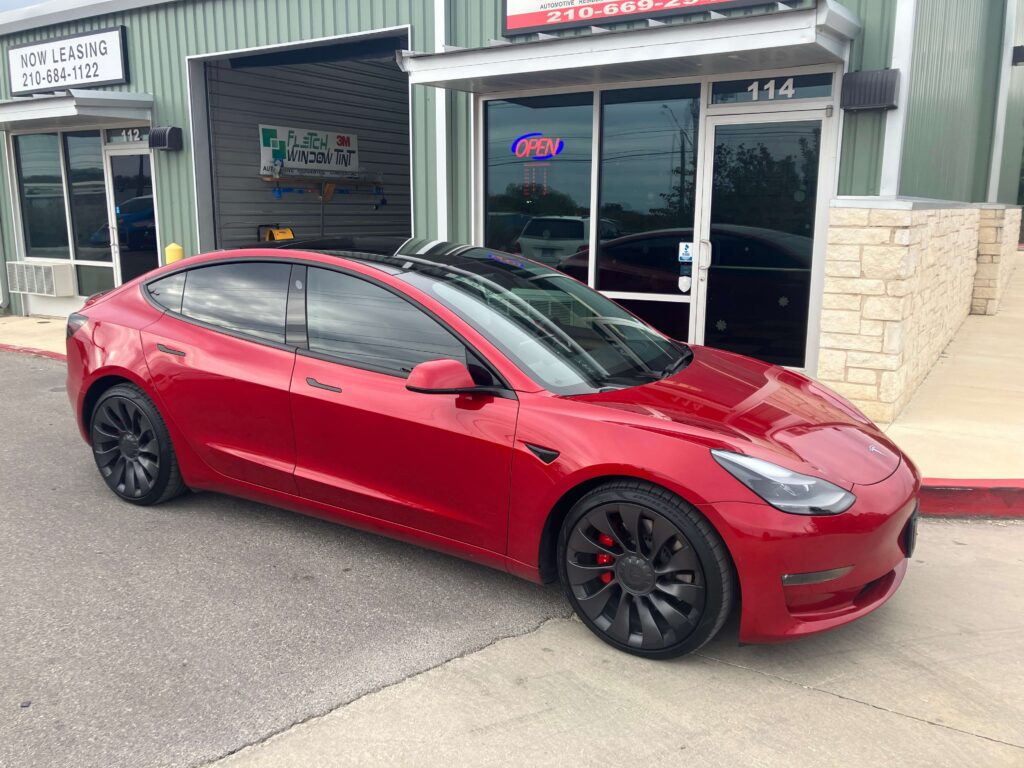
How dark is 35% tint?
35% tint is a medium shade. It blocks about 65% of visible light, so it looks clearly tinted from outside without going black. On the scale the International Window Film Association uses, a 70% film is “nearly clear” and a 15% film looks “nearly black,” and 35% sits between them.
Think of it as the khaki pants of window tint. It goes with everything, it’s legal on every side window of a Texas car, and nobody has ever written a country song about it.
The exact darkness depends on the film and the glass. Here’s how 3M’s three 35 shades measure, from 3M’s technical data sheets for Obsidian, Ceramic IR and Crystalline:
| 3M film | Reading on typical car glass (73%) | Reading on clear glass (89%) | UV blocked | Total solar energy rejected |
|---|---|---|---|---|
| Obsidian 35 | 38% | 47% | 99.4% | 51% |
| Ceramic IR 35 | 37% | 45% | 99.8% | 58% |
| Crystalline 35 | 33% | 40% | 99.9% | 60% |
The UV and solar energy figures are on the 73% car glass. So “35” on the box is a starting point, not a promise, the same way “serves four” on a frozen lasagna is a starting point. Every reading in that table still clears the Texas front-window minimum of 25% with room to spare.
What does 35% tint look like on a car?
From outside, 35% tint looks like a medium-gray smoke over the glass. In daylight, people can see shapes and outlines inside, and they can make out faces if they get close. From a few cars away, it just reads as “tinted.”
What’s behind the glass changes the look as much as the film does. The IWFA’s Automotive Education Guide puts it plainly: “The darker the interior color of the vehicle the darker the film will look and the more difficult it will be to see the occupants.” So 35% on a black truck with black seats looks darker than 35% on a white crossover with tan leather. Khakis look different on everybody, too.
The same guide tells people to look at film at different times of day and from different angles, because the sun changes everything. Everybody’s done the parking-lot version of this: walking past a nice truck, slowing down, squinting at the back glass and trying to guess the number. With 35%, that’s also how you find out the owner is still sitting in it. He’s been watching you squint the whole time.
That’s why I’d rather you see 35% next to the shades either side of it at our shop than judge it from somebody else’s car.

What does 35% tint look like at night?
At night, the view from outside depends on the cabin lights. With the cabin dark, 35% looks darker than it does at noon. With the dome light on, the inside is the bright side, so people outside can see in more easily.
From the driver’s seat, 35% after dark is easy for younger eyes and more noticeable for older ones. The clearest evidence is a 2000 study in the journal Human Factors, from back when the hottest thing in a car was a six-disc CD changer. Researchers at the Southern California College of Optometry measured contrast sensitivity, which is how well you pick out faint detail, through a car window with 37% light transmission. For drivers aged 20 to 29, 37% “did not significantly reduce contrast sensitivity.” For drivers aged 60 to 69, it did.
That 37% is almost exactly what 3M’s Ceramic IR 35 reads on typical car glass. So if you’re in your 20s, 35% at night is a non-event. If you’ve started holding the restaurant menu at arm’s length to read it, you’ll notice it more, and a lighter shade up front is worth a look.
Is 35% tint legal in Texas?
Yes. 35% tint is legal on every side window and the back window of a Texas car. Under Texas Transportation Code Section 547.613, the front side windows need “a light transmission of 25 percent or more” and “a luminous reflectance of 25 percent or less,” measured with the film and the glass together.
3M’s 35 shades read 33% to 38% on typical car glass, and 3M lists their exterior reflectance at 5% to 6% on that glass, so they clear both numbers. Khakis have never gotten anybody pulled over, and 35% on a Texas front window shouldn’t either.
The rest of the car is simpler. The Texas DPS says side windows behind the driver are “completely exempted from regulation,” and the back window can be any darkness if the car has an outside mirror on each side showing the road at least 200 feet behind. The windshield has its own rule, covered in windshield tint in Texas.
Is 35% tint dark enough for privacy?
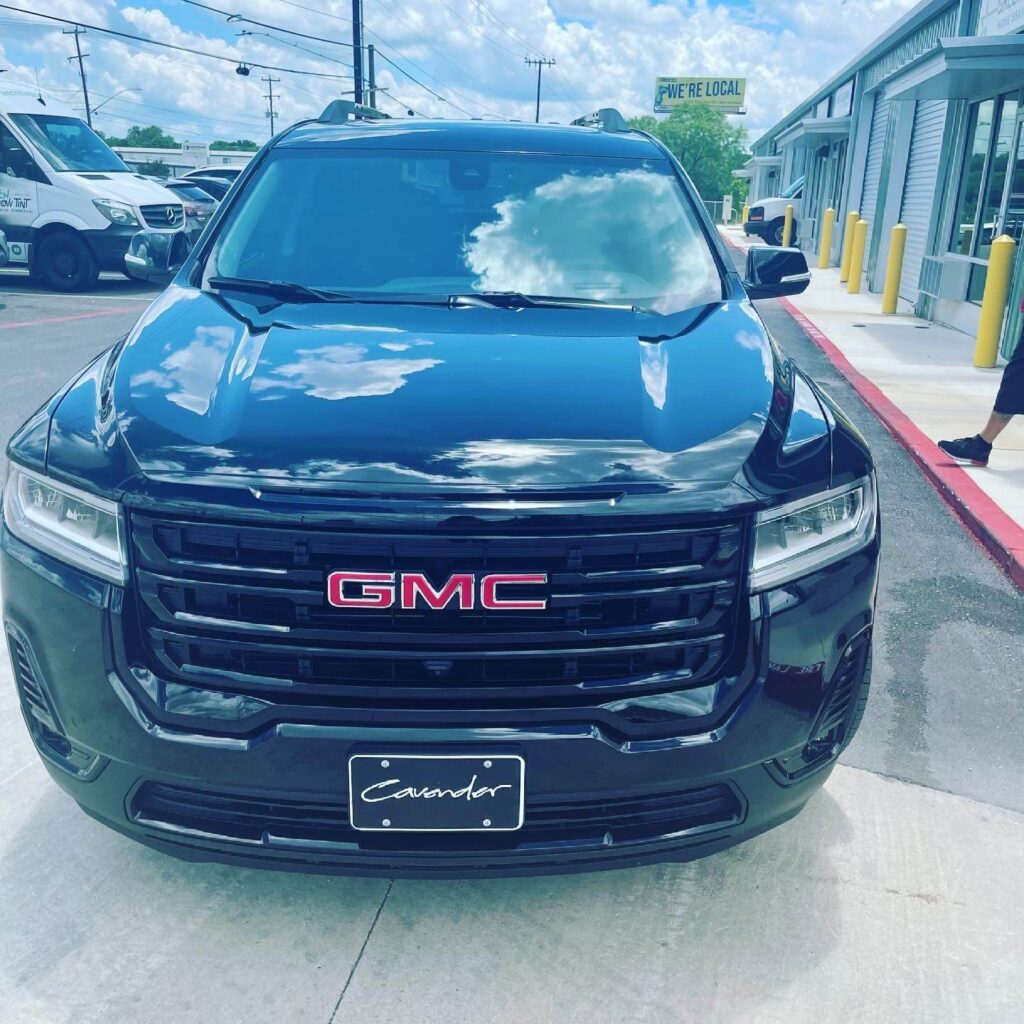
For casual privacy, yes. For hiding things, not really. In daylight, 35% stops people from seeing details at a glance, but anyone who walks up and cups their hands on the glass can see what’s on the back seat.
The IWFA guide says privacy comes down to three things: how dark the film is, how reflective it is, and the color of the interior. A dark interior helps 35% a lot. It’ll keep the laundry basket on the back seat away from traffic. It won’t stop the neighbor’s kid who presses his whole face against the glass and leaves a nose print you’ll find in October.
Does 35% tint keep your car cooler?
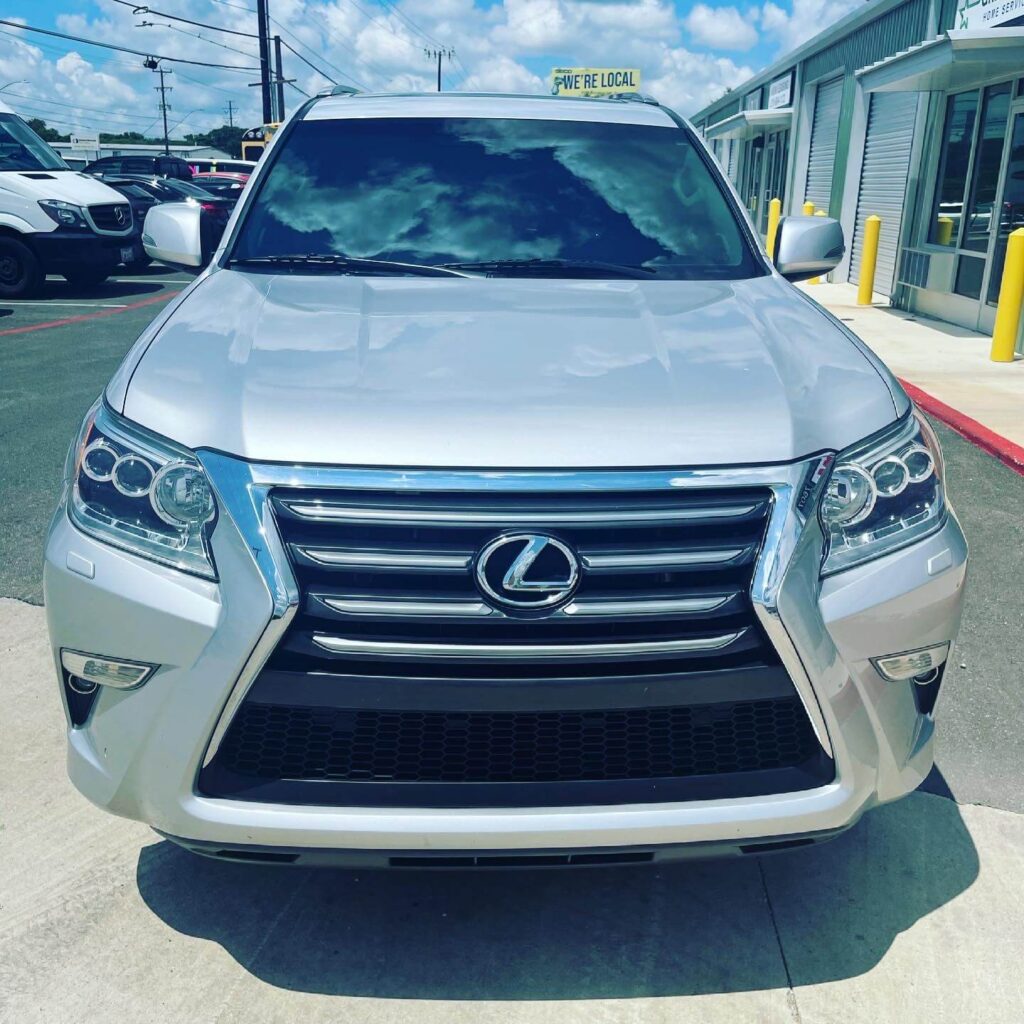
Yes, and the film matters as much as the shade. On 3M’s data sheets, the three 35 films reject 51% to 60% of total solar energy on typical car glass: Obsidian 35 at 51%, Ceramic IR 35 at 58% and Crystalline 35 at 60%. That 60% is the same figure 3M gives Obsidian 5, which is limo dark. So a 35 in the right film can take out as much heat as a far darker one.
That’s the difference between a steering wheel you can hold and one you steer with two fingertips, like a waiter carrying a sizzling fajita skillet. If heat is the main reason you’re tinting, ask about 3M Ceramic IR or 3M Crystalline in 35.
UV is the easy part. All three block 99.4% or more of UV on car glass. The Skin Cancer Foundation notes that side and back windows are tempered glass, “which does not block UVA rays effectively,” so film is doing real work there.
35% or 20%: which should you pick?
20% is darker and gives more privacy, but in Texas it’s only legal behind the driver. 35% works on every side window. Texas also lets you run 35% up front and something darker in back, which gets you both.
Picking between them is like choosing salsa at a taqueria: medium is plenty, and somebody at the table always orders hot to prove something. Our post on 20% tint covers the darker shade, and 20 vs 35 tint puts them side by side.
What we see at the shop
I’d rather sell you a 35 you love than a 20 you have to explain to an officer. We install to the Texas rule, so if a shade won’t pass up front, you’ll hear it from us before we start, not from a meter after.
Film quality shows up years later, not on day one. Eric S. wrote this in September 2026: “I’ve used Fletch for the tint on 5 different cars over the past 8 years. I use their high-quality 3M ceramic tint, and have never had issues, even years after the install.” Rajo R. set honest expectations in March 2026: “It won’t totally save you from the heat but it is a huge help, was absolutely worth it!”
Customers tell us a car takes anywhere from 45 minutes to two and a half hours. One, Simone C., wrote in May 2022 that we have a “Cool waiting room with snacks & coffee & tea,” so pace yourself.
Frequently asked questions
Can you see into a car with 35% tint?
In daylight, people outside can see shapes and outlines, and faces if they get close to the glass. A dark interior makes it harder to see in.
Is 35% tint too dark at night?
Not for younger drivers. A 2000 study found a window with 37% light transmission didn’t significantly reduce contrast sensitivity for drivers in their 20s, though it did for drivers in their 60s.
Is 35% tint legal in Texas?
Yes. Texas requires 25% or more light transmission on the front side windows, measured with the glass, and 3M’s 35 shades read 33% to 38% on typical car glass. The rear side windows are exempt.
Which is darker, 35% or 20% tint?
20% is darker. It lets 20% of visible light through, while 35% lets 35% through.
Does 35% tint block UV rays?
Yes. 3M’s 35 shades block 99.4% to 99.9% of UV on typical car glass, according to 3M’s data sheets.
How long does it take to put on 35% tint?
Our customers report anywhere from 45 minutes to two and a half hours for a car. Same-day service is usually available.
Get 35% tint in San Antonio
See 35% in person before you decide. Bring your car to our Grissom Road shop for 3M car window tint in San Antonio, with a free quote and a lifetime film warranty. For every other shade, the tint percentage chart has them all. Call (210) 669-2940. We’re open Monday to Saturday from 9:30am to 5:30pm.
Sources
- Texas Transportation Code Section 547.613, Restrictions on Windows
- Texas Department of Public Safety, Window Tinting Standards
- International Window Film Association, Automotive Window Film
- International Window Film Association, Automotive Education Guide (PDF)
- 3M Automotive Window Film Obsidian Series, Technical Data Sheet (PDF)
- 3M Automotive Window Film Ceramic IR Series, Technical Data Sheet (PDF)
- 3M Automotive Window Film Crystalline Series, Technical Data Sheet (PDF)
- LaMotte J. et al., “Effect of aftermarket automobile window tinting films on driver vision,” Human Factors, 2000
- Skin Cancer Foundation, UV Window Film and Tint

Written by Kevin “Fletch” Fletcher, co-owner of Fletch Window Tint
Kevin and his wife Sally have run Fletch Window Tint in San Antonio since 1989. The shop is one of only two 3M Prestige Dealers in the city, with more than 120,000 cars and 5,000 homes tinted. Get a free quote or call (210) 669-2940.