
Quick answer: 20% tint lets 20% of visible light through and blocks about 80%. From outside it looks dark: in daylight, people see shapes at most unless they’re right up against the glass. In Texas it’s darker than the 25% the law requires on the front side windows, so it belongs on the rear side windows and the back glass.
We’ve tinted more than 120,000 cars in San Antonio since 1989, and we’re one of only two 3M Prestige Dealers in the city. 20% is one step darker than the middle of our tint percentages guide, and it’s the shade where Texas law starts to matter.
Where can 20% tint go on a Texas car?
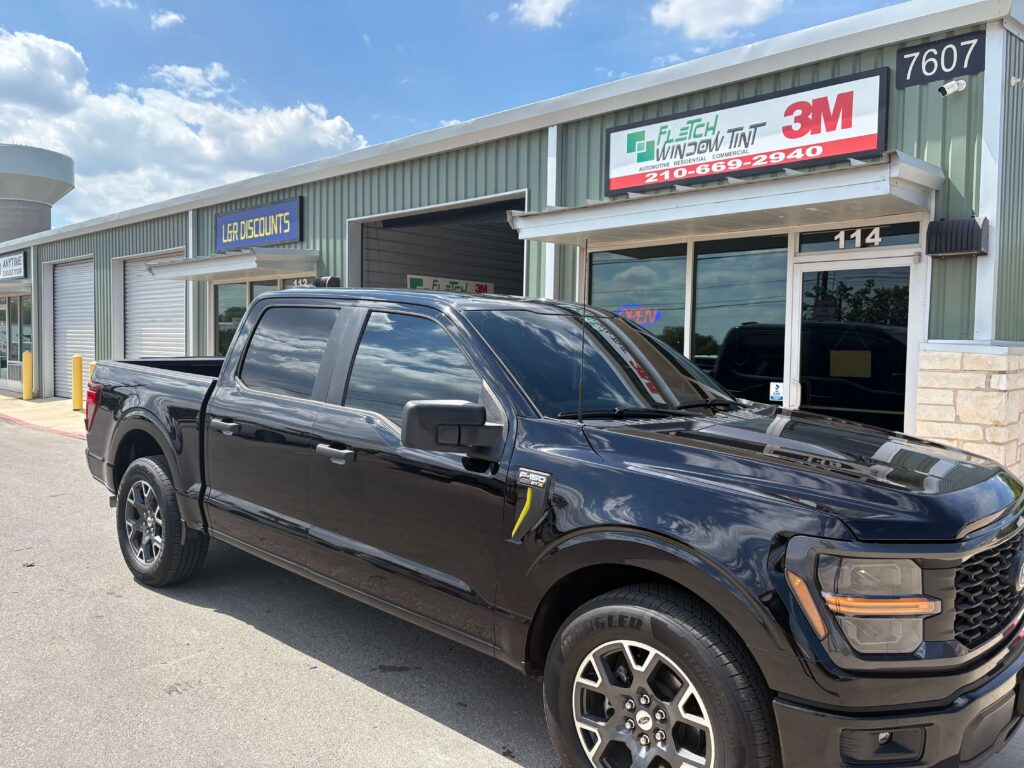
20% tint can go on the rear side windows and the back window of a Texas car, but not on the front side windows or the windshield. The front side windows need 25% or more, and 20% is darker than that. Here’s the rule window by window, from Texas Transportation Code Section 547.613:
| Window | The Texas rule | Can 20% go here? |
|---|---|---|
| Front side windows | 25% or more light transmission and 25% or less reflectance, film and glass measured together | No |
| Rear side windows | Exempt | Yes |
| Back window | Any darkness if the car has an outside mirror on each side showing the road at least 200 feet behind | Yes, with both side mirrors |
| Windshield | A clear, un-tinted UV film is allowed anywhere. Film that darkens the glass only above the AS-1 line, or in the top five inches if there’s no AS-1 line, at 25% or more light transmission and 25% or less reflectance, and not red, blue or amber | No |
The Texas DPS puts the rear side windows bluntly: they’re “completely exempted from regulation under the Texas Transportation Code.”
20% is the shade that makes a Honda Civic look like it’s driving a witness to a federal trial. The front doors are where the witness protection program ends. Put 20% there and a traffic stop starts with “Do you know why I pulled you over?” and you, unfortunately, do. The statute makes it a misdemeanor, and our post on how much a tint ticket costs in Texas covers the rest.
How dark is 20% tint?
20% tint blocks about 80% of visible light. That puts it near the dark end of the scale: the International Window Film Association says a 15% film “would appear nearly black from the exterior and make it difficult to see through the glass,” and 20% is only a step lighter.
3M’s data sheets show how much light goes missing. The 3M shades either side of 20 cut glare by 65% to 81% compared with bare car glass, depending on the film. That’s a lot of sun to lose.
From the driver’s seat on a bright afternoon, 20% feels like somebody turned San Antonio’s brightness down a few notches, the way you do with your phone in bed. It’s lovely at 3pm in August. It’s less lovely at 11pm in a dark parking lot, which is the next section.
What does 20% tint look like on a car?
From outside, 20% tint looks like dark charcoal glass. In daylight, people only see outlines if they get close. From across the street, the car just looks private.
The interior changes the look. The IWFA’s Automotive Education Guide says “the darker the interior color of the vehicle the darker the film will look,” so 20% over black seats reads close to black, and 20% over tan leather lets more shapes show through.
At night, the look depends on the cabin lights. With the cabin dark, 20% looks black. Turn on the dome light at a red light to find your sunglasses, and the witness is briefly in full view of the car next to you.
Is 20% tint too dark to drive with at night?
20% tint makes night driving harder whenever you look through it. On a Texas-legal setup, that’s when you check the rear-view mirror, look over your shoulder to change lanes, or back up.
Two studies are worth knowing. A 2000 study in Human Factors measured how well drivers pick out faint detail through tinted windows. An 18% window, close to 20%, reduced that ability even for drivers in their 20s, at the fine-detail end of the test. A 1991 Insurance Institute for Highway Safety study simulated drivers checking through the rear window before backing up. Darker glass made them less likely to spot a child or road debris behind the car.
The 1991 study is old enough to have a mortgage and a bad knee, but its conclusion hasn’t aged: “the safety of backing maneuvers is compromised for all drivers at the lowest luminous transmittance (darkest tinting) levels studied.” The witness, sadly, can’t see the curb either.
None of that makes 20% in back a bad choice. It means a reversing camera earns its keep, and backing out of a dark driveway deserves a slower speed than you’d use at noon.
Does 3M make 20% tint?
Not in the three 3M films we install. 3M’s current data sheets list Obsidian in 5, 15, 25, 30, 35 and 50, Ceramic IR in the same shades plus 70, and Crystalline in 15, 30, 35, 40, 50, 60, 70 and 80. So “20” with 3M film means picking the shade just darker or just lighter. When someone asks us for 20 on the back windows, we put on 15.
If you came here set on exactly 20, take a moment. I’ll wait.
Here’s how the shades either side of 20 read on typical car glass that lets 73% of light through, from those same data sheets:
| 3M film | Reading on typical car glass | Glare cut compared with bare glass |
|---|---|---|
| Crystalline 15 | 14% | 81% |
| Ceramic IR 15 | 16% | 78% |
| Obsidian 15 | 18% | 75% |
| Obsidian 25 | 24% | 67% |
| Ceramic IR 25 | 25% | 65% |
| Crystalline 30 | 29% | 61% |
Look at Obsidian 25: it reads 24% on 3M’s reference glass. The name on the film and the reading on your window aren’t the same thing, and the reading is the one the law cares about. That’s why, when someone asks us for 25 on the front doors, we install 30. Glass isn’t 100% clear, so on the cars we see, 30 typically meters between 25 and 27%.
Can you get 20% on the front windows with a medical exemption?
Possibly. Texas law has a medical defense that can cover front windows darker than 25%. Section 547.613(e) makes it “a defense to prosecution” when the driver or a passenger “is required for a medical reason to be shielded from direct rays of the sun.”
The Texas DPS explains what that takes. You need a signed statement from a licensed physician or licensed optometrist that names the driver or passenger and says the tint is necessary to safeguard their health. DPS stopped issuing window tint exemption certificates on January 1, 2019, so the signed statement is the proof. Keep it in the car and show it to an officer at a traffic stop. The glove box works. The fridge at home next to the dentist reminder doesn’t.
Our post on the Texas tint exemption walks through it step by step.
What we see at the shop
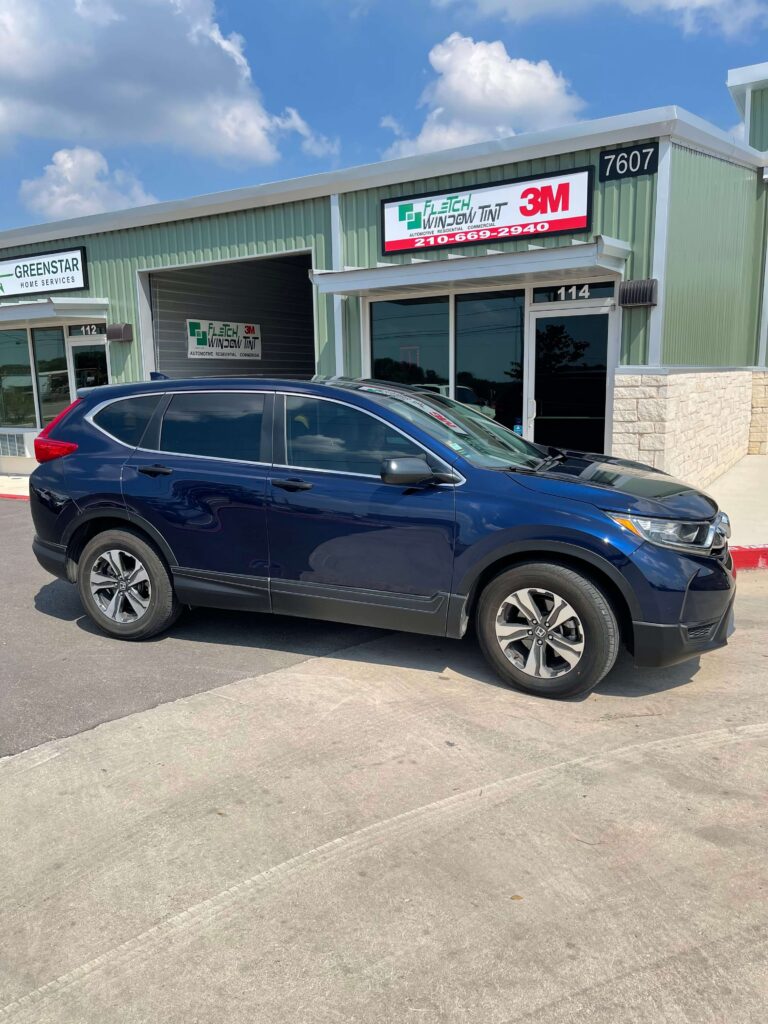
We install to the Texas rule. If you ask for 20% on the front doors, I’ll tell you before we start, not after. When we have that talk, I’d rather be the one who mentions the law than the officer with the meter.
If your car already has film that’s too dark or gone purple, we take it off as part of the new tint job. Purple tint isn’t a style. It’s dyed film quitting, and it didn’t give two weeks’ notice.
Every option is worth talking through before a dark shade goes on, night visibility included. Alyssa G. wrote this in May 2023: “They explained and presented every option I had regarding my window tint.” That’s the conversation I’d want anyone to have before 20% goes on the back glass.
Customers tell us a car takes anywhere from 45 minutes to two and a half hours, and same-day service is usually available.

Frequently asked questions
Is 20% tint legal in Texas?
On the rear side windows, yes, and on the back window if the car has an outside mirror on each side. On the front side windows, no: Texas requires 25% or more light transmission there, measured with the glass.
Can you see out of 20% tint at night?
Yes, but it’s harder, especially when backing up in a dark spot. Research has found that darker tint makes drivers less likely to spot low-contrast things like a child or debris behind the car.
Can people see into a car with 20% tint?
In daylight, mostly not unless they’re close to the glass. At night with the cabin lights on, they can see in more easily.
Which is darker, 20% or 35% tint?
20% is darker. It lets through 20% of visible light, while 35% lets through 35%.
Can I put 20% tint on my front windows with a medical exemption?
Possibly. Texas law gives a medical defense when the driver or a passenger needs to be shielded from the sun for a medical reason. DPS says you need a signed statement from a licensed physician or optometrist, kept in the car.
Does 20% tint fade?
Quality film shouldn’t. 3M says its Obsidian series uses infused technology for color retention and fade resistance, and every film we install carries a lifetime film warranty that covers discoloring.
Get 20% tint where Texas allows it
Want privacy in back and a legal view up front? We’ll put 15%, the 3M shade we use for 20, where Texas allows it and match the front windows to the law. Bring your car to our Grissom Road shop for window tint in San Antonio, with a free quote and a lifetime film warranty. For a lighter option, read 35% tint or compare 20 vs 35 tint, and for every shade, see the full tint percentage chart. Call (210) 669-2940. We’re open Monday to Saturday from 9:30am to 5:30pm.
Sources
- Texas Transportation Code Section 547.613, Restrictions on Windows
- Texas Department of Public Safety, Window Tinting Standards
- International Window Film Association, Automotive Window Film
- International Window Film Association, Automotive Education Guide (PDF)
- 3M Automotive Window Film Obsidian Series, Technical Data Sheet (PDF)
- 3M Automotive Window Film Ceramic IR Series, Technical Data Sheet (PDF)
- 3M Automotive Window Film Crystalline Series, Technical Data Sheet (PDF)
- LaMotte J. et al., “Effect of aftermarket automobile window tinting films on driver vision,” Human Factors, 2000
- Freedman M., Zador P.L., Staplin L.K., “Effects of Visibility of Reduced Transmittance Film on Automobile Rear Windows,” Insurance Institute for Highway Safety, 1991

Written by Kevin “Fletch” Fletcher, co-owner of Fletch Window Tint
Kevin and his wife Sally have run Fletch Window Tint in San Antonio since 1989. The shop is one of only two 3M Prestige Dealers in the city, with more than 120,000 cars and 5,000 homes tinted. Get a free quote or call (210) 669-2940.