
Quick answer: Ceramic tint blocks more heat than carbon tint. Kelley Blue Book rates ceramic at 60% to 70% of total solar energy rejected and carbon at up to 45%. Both are metal-free, so neither interferes with your phone or GPS, and both resist fading. Carbon costs less and has a dark, matte look.
We’ve tinted more than 120,000 cars in San Antonio since 1989, and we install both 3M carbon film and 3M Ceramic IR at our shop on Grissom Road. This comparison is part of our guide to the types of window tint.
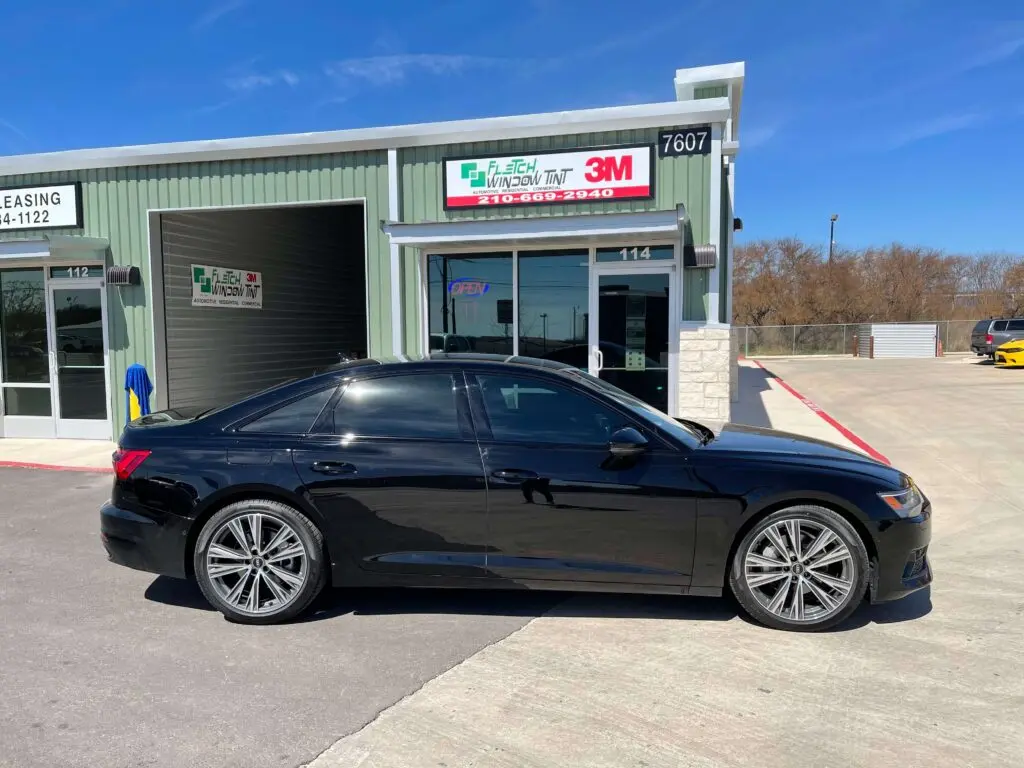
Ceramic vs carbon tint at a glance
Carbon and ceramic are the two metal-free films that sit between entry-level dyed tint and the top of the range. They match on signals and on fading. They split on heat, price and looks.
| Feature | Carbon tint | Ceramic tint |
|---|---|---|
| What’s in it | Carbon instead of dye | Nano-ceramic particles that absorb infrared |
| Total solar energy rejected | Up to 45% (Kelley Blue Book) | 60% to 70% (Kelley Blue Book); 51% to 66% for 3M Ceramic IR, by shade |
| Infrared rejected | Kelley Blue Book lists “no infrared ray rejection” as its main con | 78% to 95% for 3M Ceramic IR, by shade |
| UV blocked | Up to 99% (Kelley Blue Book) | Up to 99.9% for 3M Ceramic IR |
| Look | Dark and matte, no shine | Neutral color with a cool blue tone on 3M Ceramic IR |
| Fading | “Prevents fading” (Kelley Blue Book) | Covered against discoloring by our lifetime film warranty |
| Phone and GPS | No metal, no interference | No metal, no interference |
| Price | Costs less | Costs more |
Somewhere in the back of your head, a small suspicious voice is saying “ceramic” is a word tint shops made up to charge more. Fair. That voice has saved you from a lot of extended warranties at the electronics store. So the heat numbers on this page come from Kelley Blue Book, the window film industry’s trade association and 3M’s own data sheets, not from us.
What’s the difference between carbon and ceramic tint?
The difference between carbon and ceramic tint is how each one handles infrared, the invisible part of sunlight you feel as heat. Carbon darkens the glass and soaks up some of the sun’s energy along with the light. Ceramic adds nano-ceramic particles built to absorb infrared, and the International Window Film Association’s automotive guide says those particles absorb far more efficiently than dyes do.
That matters because infrared is about 53% of the sun’s energy, against 44% for visible light and 3% for UV, by the IWFA’s count. A film that’s weak on infrared is weak on half the problem.
Infrared is the heat that turns a seatbelt buckle into a branding iron by 3pm. It’s also why you now unbuckle with two fingertips, slowly, like you’re defusing something.
How much more heat does ceramic tint block than carbon?
Ceramic blocks a lot more. Kelley Blue Book’s tint guide puts carbon at up to 45% of total solar energy rejected and ceramic at 60% to 70%. 3M’s Ceramic IR technical data sheet shows 51% to 66% of total solar energy rejected depending on the shade, and 78% to 95% of infrared.
Total solar energy rejected is the share of all the sun’s energy (visible light, UV and infrared) that the film keeps out of the car. It’s the closest thing tint has to a single “how much cooler” number.
Fifteen to twenty-five points doesn’t sound like much on paper. In a black car in a Costco parking lot, it’s the difference between getting in and opening all four doors to walk away for a while. You know, the way you’d treat a pizza oven. If heat is your main complaint, start with our 3M ceramic window tint page.
Is ceramic or carbon tint better for Texas heat?
For a car that parks outside in San Antonio, ceramic is usually the better buy, because heat is the problem you’re paying to fix. Carbon makes sense when the car lives in a garage, the drives are short, or the dark matte look matters more to you than the last bit of heat.
Heat costs you at the pump, too. Under very hot conditions, running the AC can cut a conventional car’s fuel economy by more than 25%, especially on short trips. That’s from fueleconomy.gov, the site run for the Department of Energy and the EPA. A film that keeps more heat out gives the AC less to fight.
An old post on this blog said San Antonio summers can be “hotter than a Jalapeno pepper.” That undersells it. Jalapeños get to spend July in the fridge.
If your car sleeps outside, I don’t think carbon is the money-saver it looks like on the quote. You pay less once, then you pay in sweat every afternoon from May to October.
Do carbon and ceramic tint fade or interfere with signals?
Neither one does. Carbon gets its color from carbon instead of dye, and Kelley Blue Book counts “prevents fading” among its strengths. Neither film has metal in it. The IWFA advises a non-metal film for cars with antennas built into the glass, because conductive films can interfere with radio and phone signals. 3M says Ceramic IR won’t interfere with GPS, satellite radio or mobile devices, including 5G.
Both films get the same lifetime film warranty from us, covering bubbling, peeling and discoloring.
So the next time your call drops under an overpass and you glare at the window, you can stop. It was the overpass.
Which looks better, carbon or ceramic tint?
Carbon has a dark, matte finish with no mirror shine. 3M Ceramic IR has what 3M calls a neutral color with a cool blue tone. It comes in shades from very dark (5% of the light let through) to light (64%), so you can pick heat rejection without picking darkness.
Darkness has its own rules in Texas. Front side windows have to let through 25% or more of the light. Side windows behind the driver have no limit, and neither does the back window if the car has outside mirrors on both sides, under Transportation Code 547.613. Texas DPS lays out the same standards.
Carbon is the look for drivers who want the car to resemble the getaway vehicle in a movie where nobody gets caught. Ceramic is for drivers who want the heat gone and don’t need the car to look like it has secrets.
When is carbon tint the right call?
Carbon is the right call when heat isn’t the main thing you’re fighting. That usually looks like one of these:
- The car parks in a garage at home and at work.
- Most of your driving is short trips or after dark.
- You want a dark, matte look more than the last bit of heat rejection.
- You want a metal-free film that won’t fade, at a lower price than ceramic.
If that’s you, our carbon window tint page has the details. Carbon isn’t the consolation prize. It’s the right answer for a car that spends its afternoons indoors like a house cat.
What we see at the shop
We install both films, so I don’t have a horse in this race beyond wanting you to like your car in five years. When someone asks me carbon or ceramic, my first question isn’t about tint. It’s “where does the car sleep?”
Heat is what customers notice. Of our Google reviews, 31 talk about the heat difference or a cooler cabin. Two of them, word for word:
“Already can feel the heat difference from the 3M ceramic tint.” Patrick R., April 2022
“The tint looks flawless, and it has made a noticeable difference in reducing heat and glare.” Alan F., October 2024
Most cars are done the same visit. Customers report anywhere from about 45 minutes to two and a half hours, and Ross D.’s F250 was done in under two hours. If you’re leaning ceramic, read whether ceramic tint is worth it next, or start with what ceramic tint is.
I’ve been tinting cars since 1989, long enough to remember when the big tint question was whether the film would turn purple before or after the car was paid off. Carbon and ceramic both retired that question. Now it’s only about heat.
Frequently asked questions
Is ceramic tint better than carbon tint?
Ceramic is better for heat. It rejects more infrared and more total solar energy than carbon, by Kelley Blue Book’s figures and 3M’s own data. Carbon costs less and has a dark, matte look, and both are metal-free.
What’s the difference between ceramic tint and regular tint?
“Regular” tint usually means dyed film, which darkens the glass with dye and can fade over time. Ceramic tint uses nano-ceramic particles to absorb infrared heat, so it blocks more heat at the same darkness and has no metal to interfere with signals.
Does carbon tint block heat?
Yes, some. Kelley Blue Book puts carbon at up to 45% of total solar energy rejected, against 60% to 70% for ceramic. It also blocks up to 99% of UV.
Does carbon tint fade or turn purple?
Carbon gets its color from carbon instead of dye, so it doesn’t fade the way dyed film can. Every car film we install carries a lifetime film warranty against discoloring.
Can ceramic tint be as dark as carbon?
Yes. 3M Ceramic IR comes as dark as 5% light let through. Texas front side windows have to let through 25% or more. The darkest shades go on the rear side windows, and on the back window if the car has outside mirrors on both sides.
Get the right film for your car
Tell us what you drive and where it parks. We’ll give you a free quote on 3M ceramic window tint in San Antonio or on carbon window tint at our shop on Grissom Road. For the other film types, see our full guide to the types of window tint. Same-day is usually available, or call (210) 669-2940.
Sources
- Kelley Blue Book, Car Window Tinting: 7 Things You Need to Know (2025)
- International Window Film Association, Automotive Education Guide (2026)
- 3M Ceramic IR Series technical data sheet
- 3M Ceramic IR Series brochure
- fueleconomy.gov, Fuel Economy in Hot Weather (Department of Energy and EPA)
- Texas Transportation Code 547.613
- Texas DPS, Window Tinting Standards

Written by Kevin “Fletch” Fletcher, co-owner of Fletch Window Tint
Kevin and his wife Sally have run Fletch Window Tint in San Antonio since 1989. The shop is one of only two 3M Prestige Dealers in the city, with more than 120,000 cars and 5,000 homes tinted. Get a free quote or call (210) 669-2940.